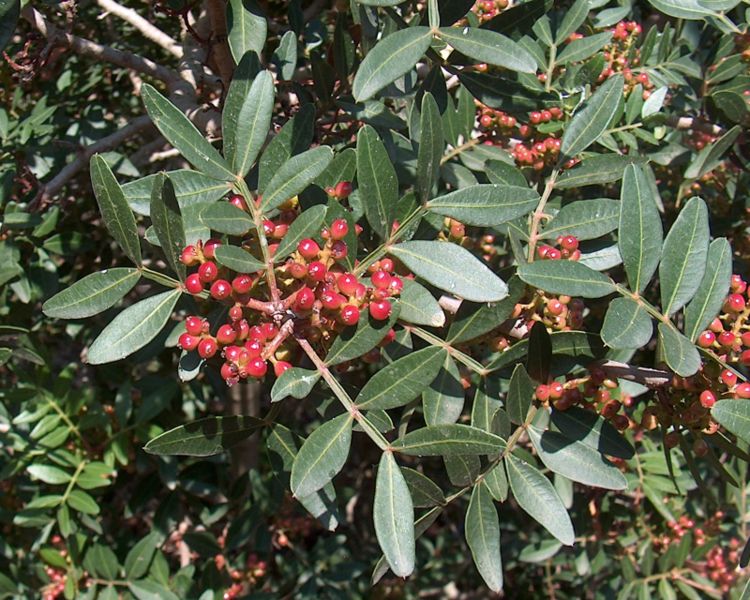
Mastic is an evergreen shrub of the Anacardiaceae family.
The mastic is a widespread species throughout the Mediterranean basin, mainly in coastal regions, in the plains and low hills, with a strong smell of resin. It is located along the coastline of the province of Salerno. Generally it does not grow beyond 400-600 meters. The plant has a bushy habit, with a height of up to 3-4 meters. The plant releases a strong resinous smell.
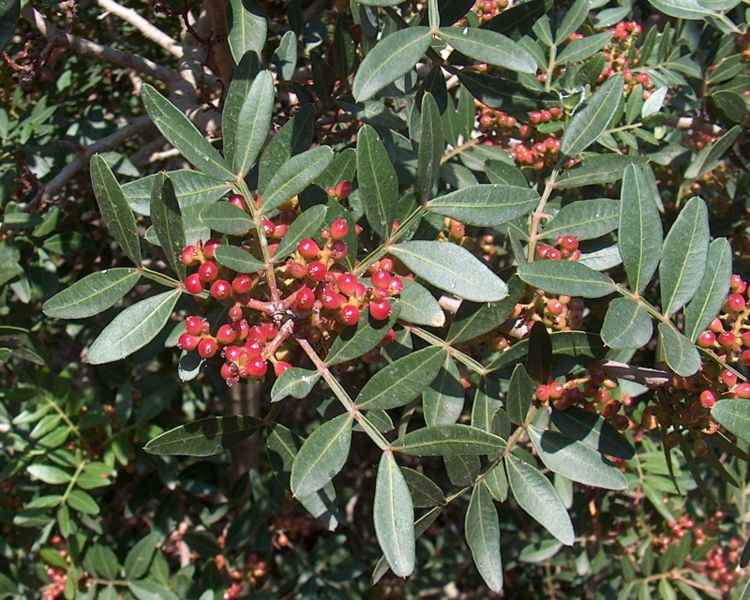
The leaves are alternate, compound paripinnate, consisting of 6-10 ovate-elliptic leaves with entire margin and obtuse apex. The petiole is flattened and winged. The entire leaf is hairless.
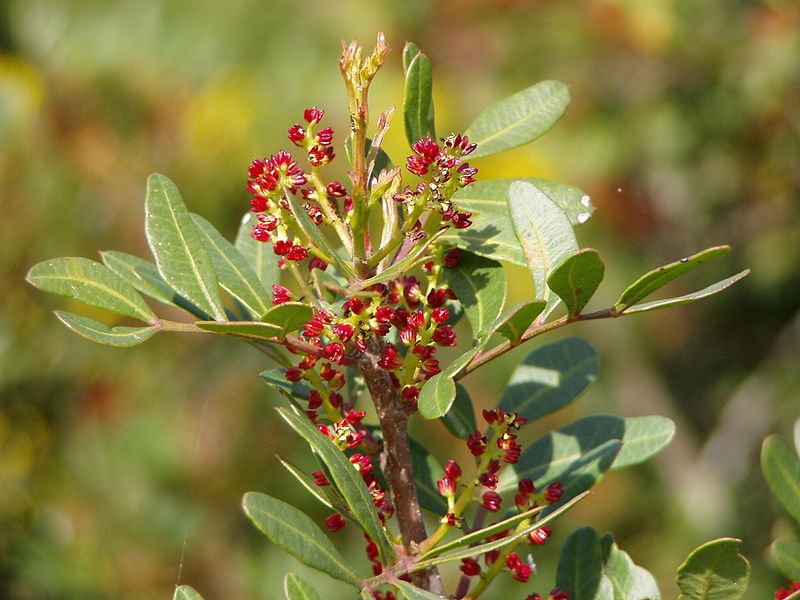
The mastic is a dioecious species, with separate male and female flowers on different plants. In both sexes, the flowers are small and reddish in colour. The fruit is a small spherical or ovoid drupe, 4-5 mm in diameter, red in colour, becoming almost black during ripening.
The plant is in bloom in spring, from April to May. Red fruits are clearly visible in the middle of summer and autumn, and ripen in winter.
In the past, the fruits were boiled and squeezed to extract a type of oil used as fuel for lighting (the Roman lanterns) and as a substitute of olive oil. The drupe of mastic can also be eaten such as the pistachio.
Photo gallery
Notes
Sandro Pignatti (1982). Flora d'Italia. Volume 2. Bologna, Edagricole: 66